 22:16
22:16 What Is Git?
Git Version Control System
Git is the distributed version control system used by virtually every software project. It tracks changes to your code over time, enables collaboration through branching and merging, and lets you revert to any previous state. GitHub, GitLab, and Bitbucket provide hosted Git repositories.
How Git Works
Git records every change as a commit — a snapshot of your entire project at a point in time. Branches let you work on features independently. Pull requests (GitHub) or merge requests (GitLab) facilitate code review before merging.
Git is distributed: every developer has a full copy of the repository history. You can commit, branch, and review history without network access. Push and pull sync changes with remote repositories (GitHub, GitLab).
The basic Git workflow: git add (stage changes), git commit (save a snapshot), git push (upload to remote). For teams: branch from main, commit your work, open a pull request, get review, merge.
Why Developers Use Git
Git is non-negotiable for software development. Every codebase, every team, every CI/CD pipeline uses Git. Understanding Git — branching, merging, rebasing, resolving conflicts — is a fundamental developer skill.
Key Concepts
- Commit — A snapshot of your project at a point in time — includes a message describing what changed and why
- Branch — An independent line of development — create branches for features, merge them when done
- Merge/Rebase — Combining branches. Merge creates a merge commit. Rebase replays commits on top of another branch for linear history.
- Pull Request — A GitHub/GitLab feature for proposing and reviewing changes before merging into the main branch
- Remote — A hosted repository (GitHub, GitLab) that team members push to and pull from
- Stash — Temporarily save uncommitted changes to switch branches — git stash saves, git stash pop restores
Essential Git Commands
bash
# Start a new feature
git checkout -b feature/user-auth

# Stage and commit changes
git add src/auth.ts src/middleware.ts
git commit -m "Add JWT authentication middleware"

# Push and create pull request
git push -u origin feature/user-auth

# Update your branch with latest main
git fetch origin
git rebase origin/main

# Resolve conflicts, then continue
git add .
git rebase --continue
Learn Git — Top Videos
22:16 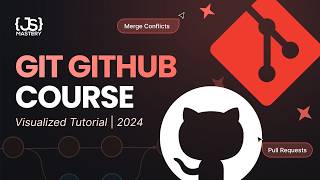 1:12:07
 Git & GitHub Tutorial | Visualized Git Course for Beginner & Professional Developers in 2024 JavaScript Mastery
770.3K views · 16.7K likes · 1 year ago
 36:57
36:57 Git and GitHub - 0 Experience to Professional in 1 Tutorial (Part 1) SuperSimpleDev
734.4K views · 19.3K likes · 5 years ago
 8:18
8:18  11:58:41
 🚀🔥 Complete Backend Development in One Day (2025) | Hindi | Notes | GitHub | Free Certification Complete Coding by Prashant Sir
515.4K views · 10.7K likes · 11 months ago
 1:23
1:23 Git Educators

Corey Schafer
@coreyms
Data Science
Welcome to my Channel. This channel is focused on creating tutorials and walkthroughs for software developers, programme...
1.5M Subs
268 Videos
18.3K Avg Views
2.21% Engagement

TechWorld with Nana
@techworldwithnana
Data Science
Helping millions of engineers to advance their careers with DevOps & Cloud education 💙 I create new videos every month...
1.4M Subs
152 Videos
80.5K Avg Views
4.18% Engagement

GitHub
@github
AI Coding
GitHub is the AI-powered developer platform to build, scale, and deliver secure software. We make it easier for develope...
602K Subs
2.7K Videos
3.9K Avg Views
3.92% Engagement

CodingEntrepreneurs
@codingentrepreneurs
AI Coding
Learn, Build, and Earn. Coding Entrepreneurs is here to help you learn the skills you need to build the projects you wan...
388K Subs
856 Videos
87.6K Avg Views
0.68% Engagement

PedroTech
@pedrotechnologies
Web Dev
Web development tutorials for everyone. Learn ReactJS, NextJS, GraphQL, Express, MongoDB and more! Join PedroTech to mas...
280K Subs
363 Videos
34.4K Avg Views
3.85% Engagement

Ashish Pratap Singh
@ashishps_1
CS
👋 Hey, I'm Ashish, a Software Engineer with over 8 years of experience working in various domains like full stack, mach...
253K Subs
36 Videos
538K Avg Views
4.36% Engagement
Frequently Asked Questions
Git vs GitHub — what's the difference?
Git is the version control system (software). GitHub is a hosting platform for Git repositories (service). Git works without GitHub. GitHub provides a web interface, pull requests, issues, and CI/CD on top of Git.
How do I undo a commit?
git revert <commit> creates a new commit that undoes the changes (safe). git reset --soft HEAD~1 un-commits but keeps changes staged (for fixing before re-committing). Never use reset --hard on shared branches.
Should I use merge or rebase?
Use merge for shared branches (preserves history). Use rebase for feature branches before merging (creates linear history). Never rebase commits that others have pulled.
Want a structured learning path?
Plan a Git Lesson →