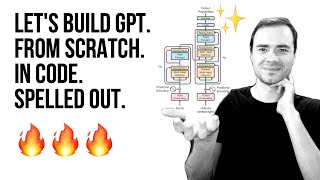
 1:56:20
 Let's build GPT: from scratch, in code, spelled out. Andrej Karpathy
6.8M views · 149.3K likes · 3 years ago
Retrieval-Augmented Generation
RAG is a technique that enhances LLM responses by retrieving relevant documents from your data before generating an answer. Instead of relying solely on the model's training data, RAG grounds answers in your specific content — reducing hallucinations and keeping responses current.
The RAG pipeline: (1) User asks a question. (2) Your system converts the question to an embedding vector. (3) It searches a vector database for similar documents. (4) The retrieved documents are added to the LLM prompt as context. (5) The LLM generates an answer grounded in that context.
RAG is how you build AI that knows about YOUR data — company docs, product manuals, codebases — without expensive fine-tuning. Tools like LangChain, LlamaIndex, and Vercel AI SDK make building RAG pipelines straightforward.
RAG powers custom knowledge chatbots, documentation search, customer support bots, and internal tools. It's the #1 pattern for building AI applications on proprietary data because it's cheaper and more flexible than fine-tuning.
1:56:20  34:05
34:05  3:31:24
  18:22
18:22 
@leilagharani
Excel. Power Query. Copilot. ChatGPT. Power BI. PowerPoint. You use them every day to automate Excel and your work - s...
@openai
OpenAI’s mission is to ensure that artificial general intelligence benefits all of humanity.

@academind
There's always something to learn! We create courses and tutorials on tech-related topics since 2016! We teach develop...

@anthropic-ai
We’re an AI safety and research company. Talk to our AI assistant Claude on claude.com. Download Claude on desktop, iOS,...
RAG retrieves relevant context at query time. Fine-tuning modifies the model's weights on your data. RAG is cheaper, faster to set up, and handles dynamic data. Fine-tuning is better for changing the model's style or behavior.
An embedding model (OpenAI, Cohere), a vector database (Pinecone, Weaviate, Cloudflare Vectorize), and an LLM API. Frameworks like LangChain or LlamaIndex tie them together.
Want a structured learning path?
Plan a RAG Lesson →