 1:23:21
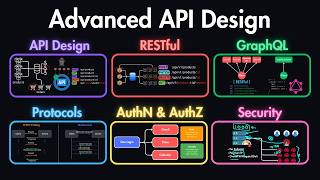
 How to Design APIs Like a Senior Engineer (REST, GraphQL, Auth, Security) Hayk Simonyan
352.2K views · 11.9K likes · 6 months ago
GraphQL Query Language
GraphQL is a query language for APIs that lets clients request exactly the data they need in a single request. Developed by Facebook in 2012 and open-sourced in 2015, it solves the over-fetching and under-fetching problems of REST APIs.
With REST, you might need 3 requests to get a user's profile, their posts, and their followers. With GraphQL, you send one query that specifies exactly the fields you want from all three resources. The server returns exactly that — nothing more, nothing less.
GraphQL uses a schema definition language (SDL) to define types. You declare your data model (types, fields, relationships) and GraphQL generates a self-documenting API. Clients can introspect the schema to discover what's available.
The ecosystem includes Apollo (client + server), Relay (Facebook's client), Hasura (auto-generated GraphQL from Postgres), and Prisma (database toolkit with GraphQL-friendly output). Most implementations run on Node.js but libraries exist for every language.
GraphQL shines in apps with complex data requirements — dashboards, social feeds, mobile apps where bandwidth matters. GitHub, Shopify, and Stripe all offer GraphQL APIs. It's particularly valuable when multiple frontend teams need different data shapes from the same backend.
# Schema definition
type User {
  id: ID!
  name: String!
  posts: [Post!]!
}

type Post {
  id: ID!
  title: String!
  likes: Int!
}

# Client query — get exactly what you need
query {
  user(id: "42") {
    name
    posts {
      title
      likes
    }
  }
} 3:49:42
  5:05
5:05  3:30:21
  1:06:28
  3:01:49
@pedrotechnologies
Web development tutorials for everyone. Learn ReactJS, NextJS, GraphQL, Express, MongoDB and more! Join PedroTech to mas...
@programwithgio
Hello & welcome to my channel! I've been coding for over a decade & my very first website was built with HTML, CSS, & P...

@apollographql
API orchestration platform for AI agents and modern applications. Connect to GraphQL and REST APIs with enterprise-prove...
@wundergraph
Dive into the world of APIs, Federation, and GraphQL with the WunderGraph channel! Our channel will introduce you to Wu...

@chillicream
The Ultimate GraphQL Platform

@tekhub160
Learn new technology through the video tutorials. Learn react native/redux, GraphQL through the video tutorials. Havin...
Use REST for simple CRUD APIs with predictable data needs. Use GraphQL when you have complex, interconnected data and multiple client types (web, mobile, API consumers) that need different data shapes.
No. GraphQL is a query language for your API, not your database. It sits between your clients and your data sources. Under the hood, GraphQL resolvers can fetch from databases, REST APIs, or any data source.
Not necessarily. Many teams use both — GraphQL for client-facing APIs and REST for internal services. GraphQL adds complexity (schema management, caching) that isn't always worth it for simple APIs.
Want a structured learning path?
Plan a GraphQL Lesson →